
France Notre-dame du Travail, Paris
History
Notre-Dame du Travail stands in the Plaisance quarter of the 14ᵗʰ arrondissement, created for a rapidly growing, working-class parish at the turn of the twentieth century. Abbé Roger Soulange-Bodin led a national subscription in the 1890s and commissioned the young architect Jules-Godefroy Astruc. Built between 1897 and 1902, the church combined social intent with technical ambition and was later listed in full as a Monument historique (2016). A Crimean-War “Bell of Sevastopol,” gifted to the parish in the 19ᵗʰ century, survives as a striking relic of that era.
Architecture
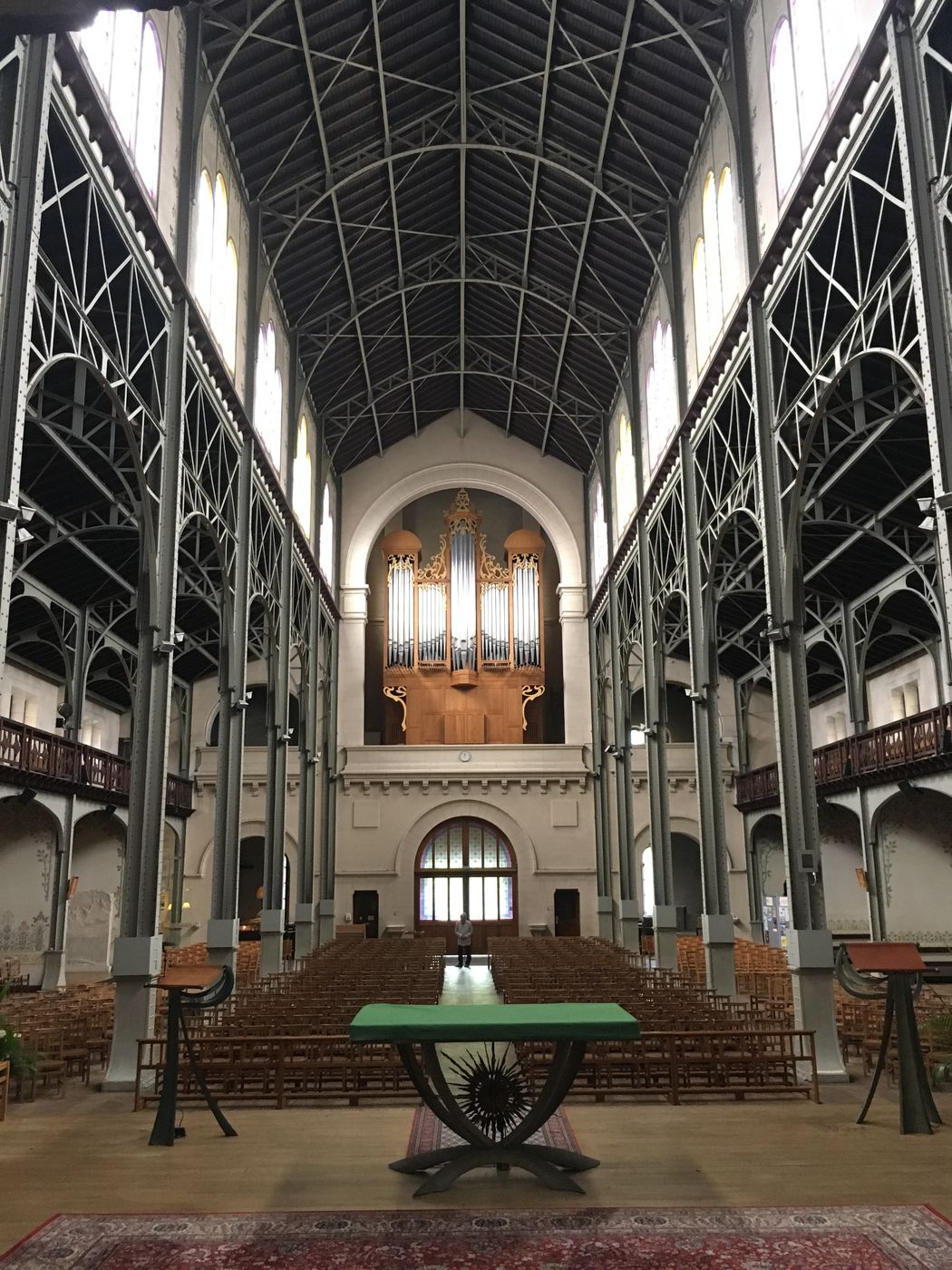
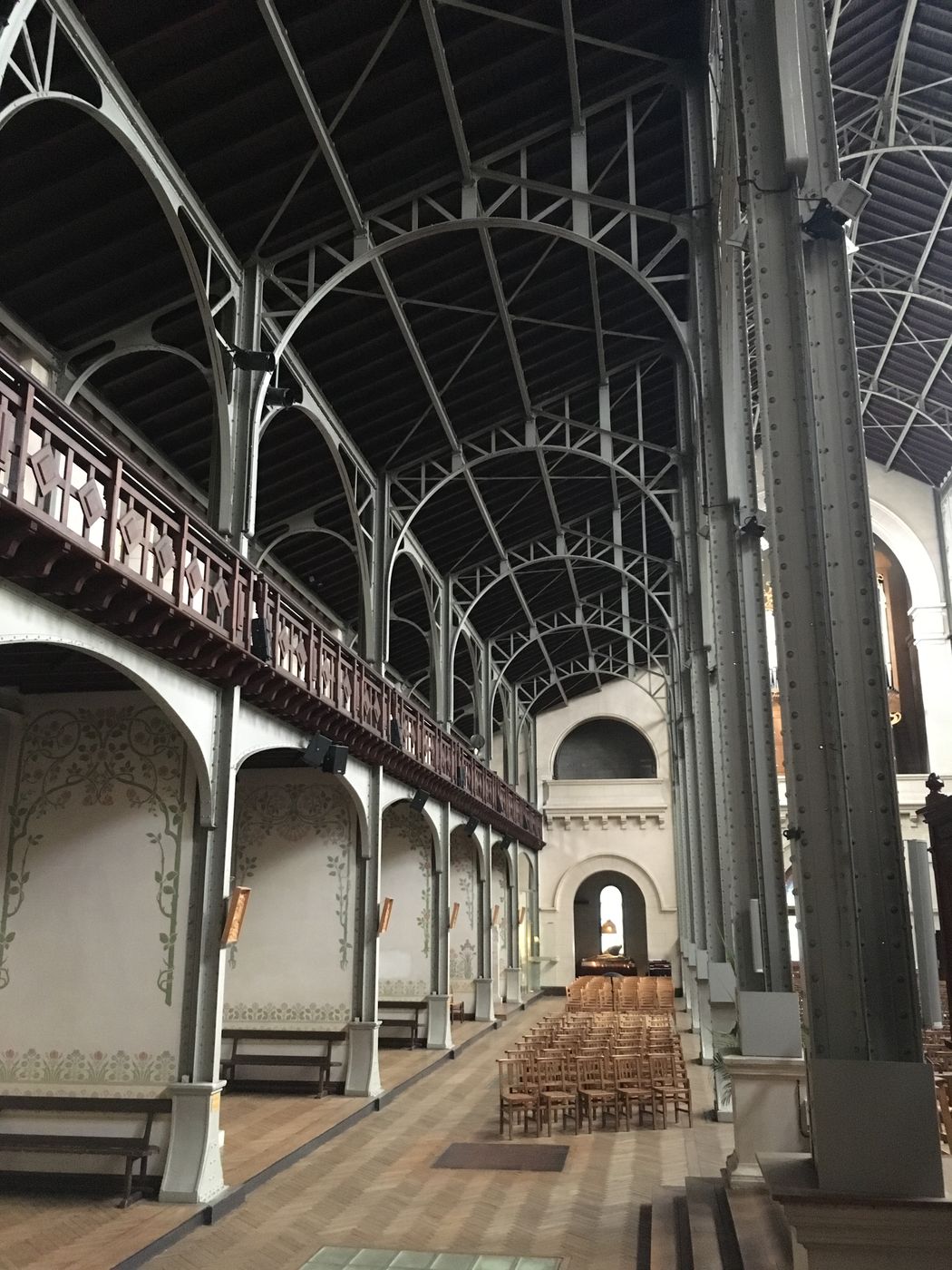
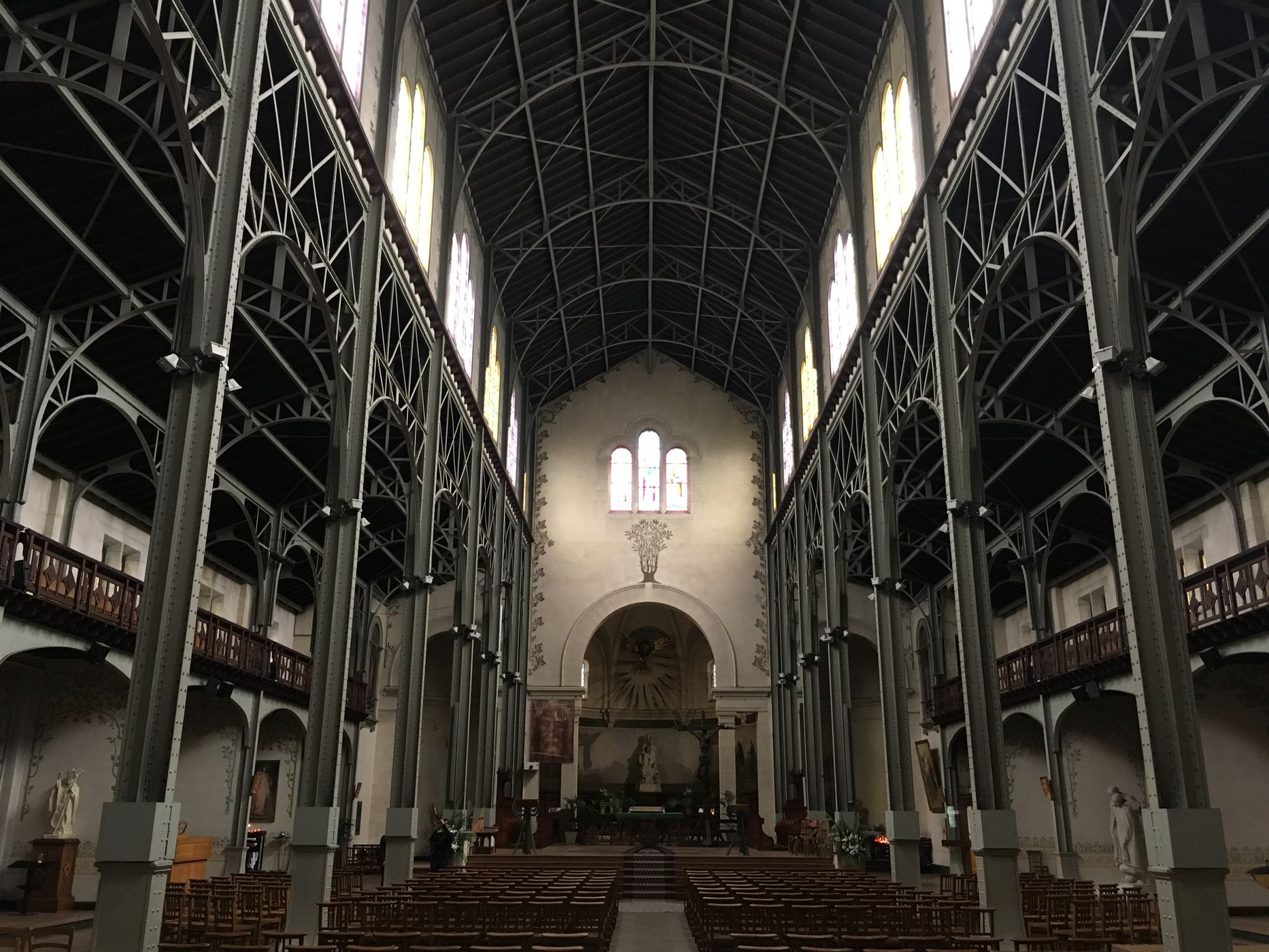
The exterior reads as sober neo-Romanesque stonework; the interior switches register to an unapologetically industrial space of slender iron columns, exposed steel trusses and light-washed clerestories—deliberately evoking the language of labour. Contrary to a persistent myth, the metal frame was not salvaged from the Palais de l’Industrie; archival research shows it was purpose-designed and fabricated (notably by Moisant & Cie) for this church. Decorative cycles and statuary honour the world of work while softening the machine-age grid.
Notre-Dame du Travail stands in the Plaisance quarter of the 14ᵗʰ arrondissement, created for a rapidly growing, working-class parish at the turn of the twentieth century. Abbé Roger Soulange-Bodin led a national subscription in the 1890s and commissioned the young architect Jules-Godefroy Astruc. Built between 1897 and 1902, the church combined social intent with technical ambition and was later listed in full as a Monument historique (2016). A Crimean-War “Bell of Sevastopol,” gifted to the parish in the 19ᵗʰ century, survives as a striking relic of that era.
Architecture
The exterior reads as sober neo-Romanesque stonework; the interior switches register to an unapologetically industrial space of slender iron columns, exposed steel trusses and light-washed clerestories—deliberately evoking the language of labour. Contrary to a persistent myth, the metal frame was not salvaged from the Palais de l’Industrie; archival research shows it was purpose-designed and fabricated (notably by Moisant & Cie) for this church. Decorative cycles and statuary honour the world of work while softening the machine-age grid.
Photography Tips
Symmetry & vanishing points: shoot down the nave to stack trusses, galleries and clerestory windows; a 24–35 mm equivalent keeps drama without heavy distortion.
Pattern studies: isolate lattice joints, column bases and the dialogue between riveted steel and stone with a fast 50 mm.
Dynamic range: the church mixes bright upper windows and shaded aisles—expose for highlights or bracket for gentle HDR.
Side-light: mornings and late afternoons skim the ironwork and throw crisp shadows across the floor.
Quiet etiquette: it’s an active parish—avoid flash during services and move discreetly.
Pattern studies: isolate lattice joints, column bases and the dialogue between riveted steel and stone with a fast 50 mm.
Dynamic range: the church mixes bright upper windows and shaded aisles—expose for highlights or bracket for gentle HDR.
Side-light: mornings and late afternoons skim the ironwork and throw crisp shadows across the floor.
Quiet etiquette: it’s an active parish—avoid flash during services and move discreetly.
Travel Information
Address: 59 rue Vercingétorix, 75014 Paris. Closest Métro: Pernety (Line 13); Gaîté (Line 13) and Montparnasse-Bienvenüe (Lines 4/6/12/13) are within walking distance. Buses 28, 58, 59, 62, 88, 91 stop at Pernety or Place de Catalogne. There is also an accessible entrance via 36 rue Guilleminot. Check the parish site for current opening times and liturgy hours.
Spot Type
Outdoor
Crowd Factor
Just a few people
Best Timing
All timings are equally good
Sunrise & Sunset
07:38 - 19:47
| current local time: 02:00
Photo Themes
Architecture
Church
iron
Locations
Paris
Île-de-France





Spot comments (0)