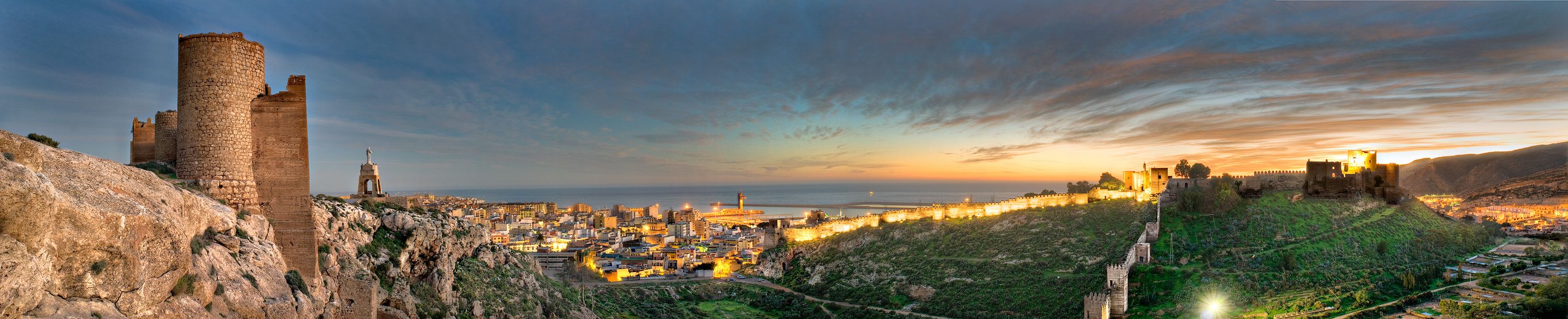

Spain Panoramic view of Almeria City from San Cristóbal Hill
San Cristóbal Hill, Almería, Spain.
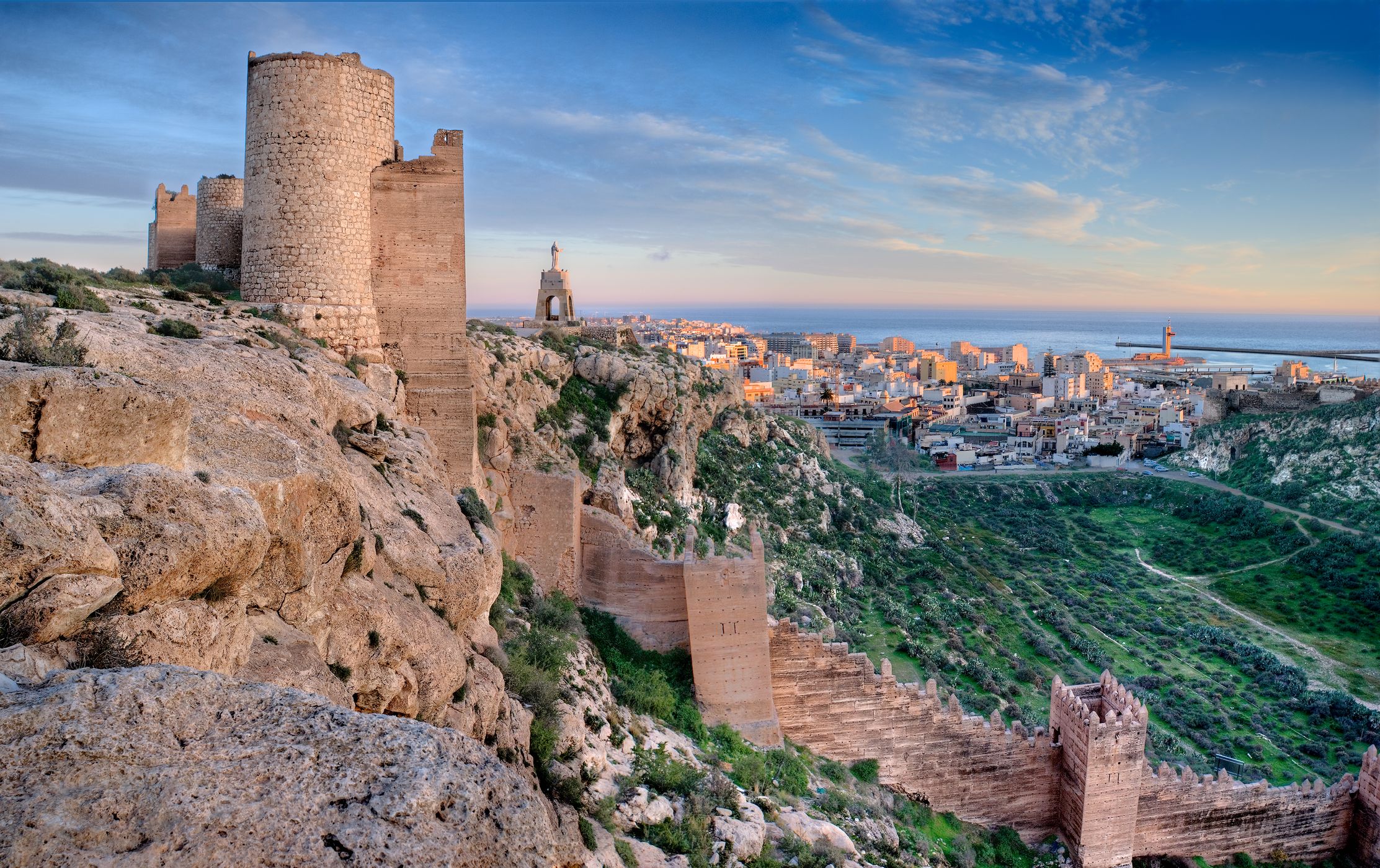
The viewpoint is located at the top of this hill, north of the city's historic center. It shares space with the Monument to the Sacred Heart of Jesus and the remains of the Jayrán wall.
Description of the Site and Its Significance
This panoramic view offers what many consider the most complete and emblematic view of Almería. The photo captures in a single shot the three fundamental layers that tell the history of the city:
The Andalusian Layer (Background): The imposing Alcazaba, the largest fortified complex built by the Arabs in Spain. With its walls, towers, and gardens, it dominates the city and symbolizes its past splendor as the capital of the Taifa kingdom.
The Medieval Layer (Center): The Jayrán Wall, an 11th-century fortified wall that descended from the Alcazaba to protect the entire medieval city. Its robust, winding perimeter is a unique testament to Caliphate military architecture.
The Modern Layer (Foreground): The Almedina neighborhood, with its characteristic popular architecture of whitewashed facades, reflects the city's humble, fishing origins. In the background, the Cathedral-Fortress and the Mediterranean Sea loom.
The significance of this view is profound: it is a visual journey through the centuries, from the splendor of the 11th century to present-day Almería, showing how the historic defenses are integrated with the modern urban fabric, all framed between the mountains and the sea.
The viewpoint is located at the top of this hill, north of the city's historic center. It shares space with the Monument to the Sacred Heart of Jesus and the remains of the Jayrán wall.
Description of the Site and Its Significance
This panoramic view offers what many consider the most complete and emblematic view of Almería. The photo captures in a single shot the three fundamental layers that tell the history of the city:
The Andalusian Layer (Background): The imposing Alcazaba, the largest fortified complex built by the Arabs in Spain. With its walls, towers, and gardens, it dominates the city and symbolizes its past splendor as the capital of the Taifa kingdom.
The Medieval Layer (Center): The Jayrán Wall, an 11th-century fortified wall that descended from the Alcazaba to protect the entire medieval city. Its robust, winding perimeter is a unique testament to Caliphate military architecture.
The Modern Layer (Foreground): The Almedina neighborhood, with its characteristic popular architecture of whitewashed facades, reflects the city's humble, fishing origins. In the background, the Cathedral-Fortress and the Mediterranean Sea loom.
The significance of this view is profound: it is a visual journey through the centuries, from the splendor of the 11th century to present-day Almería, showing how the historic defenses are integrated with the modern urban fabric, all framed between the mountains and the sea.
Photography Tips
Ideal Time:
Sunrise: The light of dawn directly illuminates the façade of the Alcazaba and the houses of La Chanca, with the city still calm. This is the moment of greatest tranquility and purest light.
Sunset and Blue Hour: The sun sets behind the city, creating a lateral, golden light that enhances the textures of the walls. Then, during the "blue hour," the spectacle is sublime. The lights of the city, the Alcazaba, and the Cathedral come on, the sky takes on an intense blue hue, and a magical atmosphere is created.
Composition:
Wide-angle: Essential (as seen in the photo) to capture the immensity of the panorama and encompass everything from the foreground to the Alcazaba in the background.
Telephoto lens: Perfect for isolating details such as the Alcazaba, the Cathedral, or a specific section of the Jayrán Wall.
Leading Lines: Use the line of the wall and the road to guide the viewer's gaze through the image, from La Chanca to the fortress.
Technique:
Tripod: Essential for shooting in low-light conditions (sunrise, sunset, blue hour) and for panoramas or HDR techniques that capture the full dynamic range of the scene.
For the blue hour, use bracketing to blend exposures and balance the city lights with the sky.
Sunrise: The light of dawn directly illuminates the façade of the Alcazaba and the houses of La Chanca, with the city still calm. This is the moment of greatest tranquility and purest light.
Sunset and Blue Hour: The sun sets behind the city, creating a lateral, golden light that enhances the textures of the walls. Then, during the "blue hour," the spectacle is sublime. The lights of the city, the Alcazaba, and the Cathedral come on, the sky takes on an intense blue hue, and a magical atmosphere is created.
Composition:
Wide-angle: Essential (as seen in the photo) to capture the immensity of the panorama and encompass everything from the foreground to the Alcazaba in the background.
Telephoto lens: Perfect for isolating details such as the Alcazaba, the Cathedral, or a specific section of the Jayrán Wall.
Leading Lines: Use the line of the wall and the road to guide the viewer's gaze through the image, from La Chanca to the fortress.
Technique:
Tripod: Essential for shooting in low-light conditions (sunrise, sunset, blue hour) and for panoramas or HDR techniques that capture the full dynamic range of the scene.
For the blue hour, use bracketing to blend exposures and balance the city lights with the sky.
Travel Information
How to Get There:
By Car: You can ascend via the AL-341 highway (which leads to Jayrán Castle and the Sacred Heart Monument). There is a free parking area at the top, just before the final climb to the viewpoint.
On Foot (Recommended for the experience): This is a steep but rewarding hike of about 20-25 minutes from the center (from the Plaza de la Constitución). You ascend through the streets of the La Chanca neighborhood or up the slope next to the walls of Jayrán.
Where to Park:
Parking at the Summit: There is a large, free parking area at the top of the hill, next to the base of the Sacred Heart Monument, just a 2-3 minute walk from the viewpoint.
Avoid parking on the slopes or narrow streets leading up.
Other Recommendations:
Best time of year: Spring and fall, when temperatures are milder for the climb. Summer can be very hot (choose early morning or late afternoon).
Equipment: Wear comfortable shoes with good grip, water, and sunscreen. For sunset, bring a coat, as it can be windy at the summit.
Safety: The viewpoint is safe, but it's a good idea to keep an eye on your belongings. Avoid climbing alone at night; it's better to go in a group.
Combine your visit: The climb can be done in conjunction with a visit to Jayrán Castle (the Moorish walls) and the Sacred Heart Monument.
By Car: You can ascend via the AL-341 highway (which leads to Jayrán Castle and the Sacred Heart Monument). There is a free parking area at the top, just before the final climb to the viewpoint.
On Foot (Recommended for the experience): This is a steep but rewarding hike of about 20-25 minutes from the center (from the Plaza de la Constitución). You ascend through the streets of the La Chanca neighborhood or up the slope next to the walls of Jayrán.
Where to Park:
Parking at the Summit: There is a large, free parking area at the top of the hill, next to the base of the Sacred Heart Monument, just a 2-3 minute walk from the viewpoint.
Avoid parking on the slopes or narrow streets leading up.
Other Recommendations:
Best time of year: Spring and fall, when temperatures are milder for the climb. Summer can be very hot (choose early morning or late afternoon).
Equipment: Wear comfortable shoes with good grip, water, and sunscreen. For sunset, bring a coat, as it can be windy at the summit.
Safety: The viewpoint is safe, but it's a good idea to keep an eye on your belongings. Avoid climbing alone at night; it's better to go in a group.
Combine your visit: The climb can be done in conjunction with a visit to Jayrán Castle (the Moorish walls) and the Sacred Heart Monument.
Spot Type
Outdoor
Crowd Factor
Nearly no other people
Best Timing
Blue hour/at night
Sunrise & Sunset
08:19 - 19:31
| current local time: 10:00
Photo Themes
City skyline
City Wall
Cityscape
Historical City
Panoramic View





Spot comments (0)