
USA The old Sage Crest Drive-In Yerington
Just outside Yerington in western Nevada, the remains of the old Sage Crest Drive-In sit in the open desert like a deserted stage set. It used to be the town’s open-air cinema: a place where families drove out at dusk, parked facing the giant screen and watched films under a very generous amount of sky. Today it no longer shows movies, but the site survives as a striking relic of mid-twentieth-century drive-in culture and a curious landmark for anyone interested in history, ruins or photography.
The history of the Sage Crest Drive-In goes back to the early 1950s, when a local family built a drive-in theatre on the edge of town to serve Yerington and the surrounding farming communities. It opened around 1953–1954, originally under a simple “Drive-In” name, with space for a few hundred cars and family-friendly films on the programme. Over time it took on the name Sage Crest, a nod to the low, scrub-covered hills around it. Like many rural drive-ins it had an uneven life: long summers of regular screenings, periods of closure when business dipped, then a relaunch in the late 1980s with new owners and a renewed push to draw crowds, including Spanish-language screenings and community events. By the mid-1990s, economic and technical pressures finally caught up; after its final season in 1995, the projectors went dark for good and the drive-in passed into public hands.
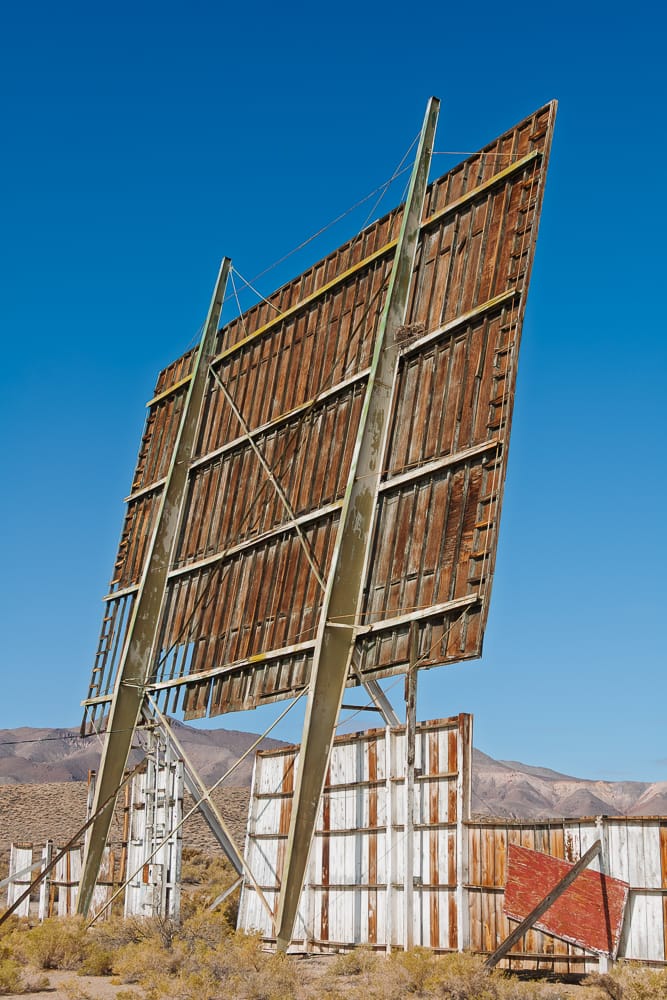
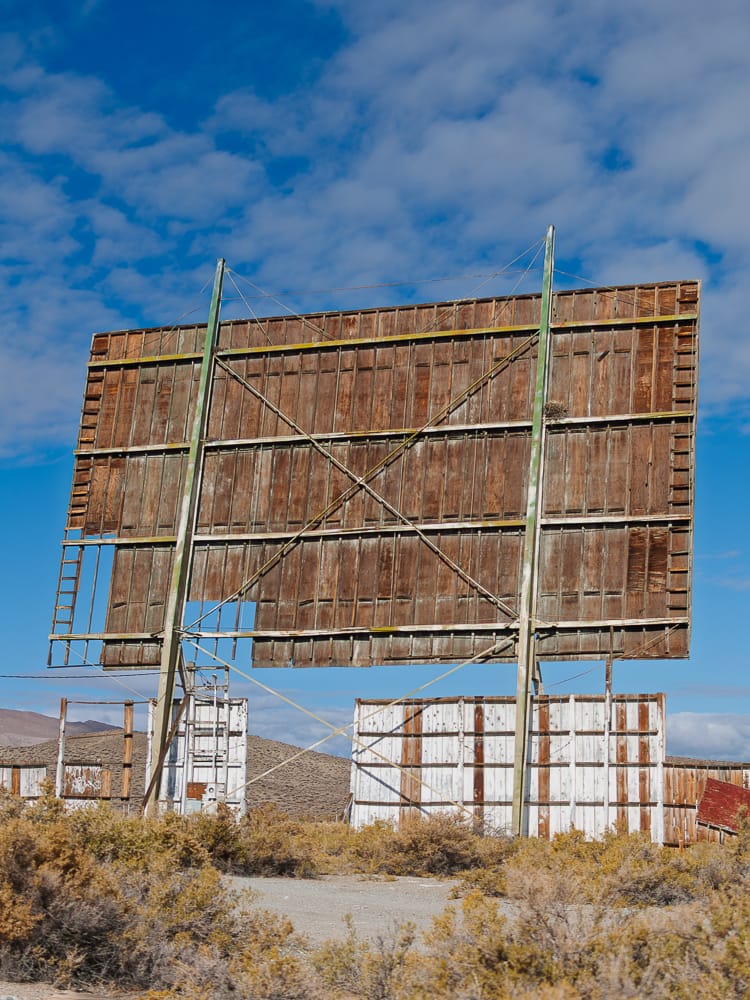
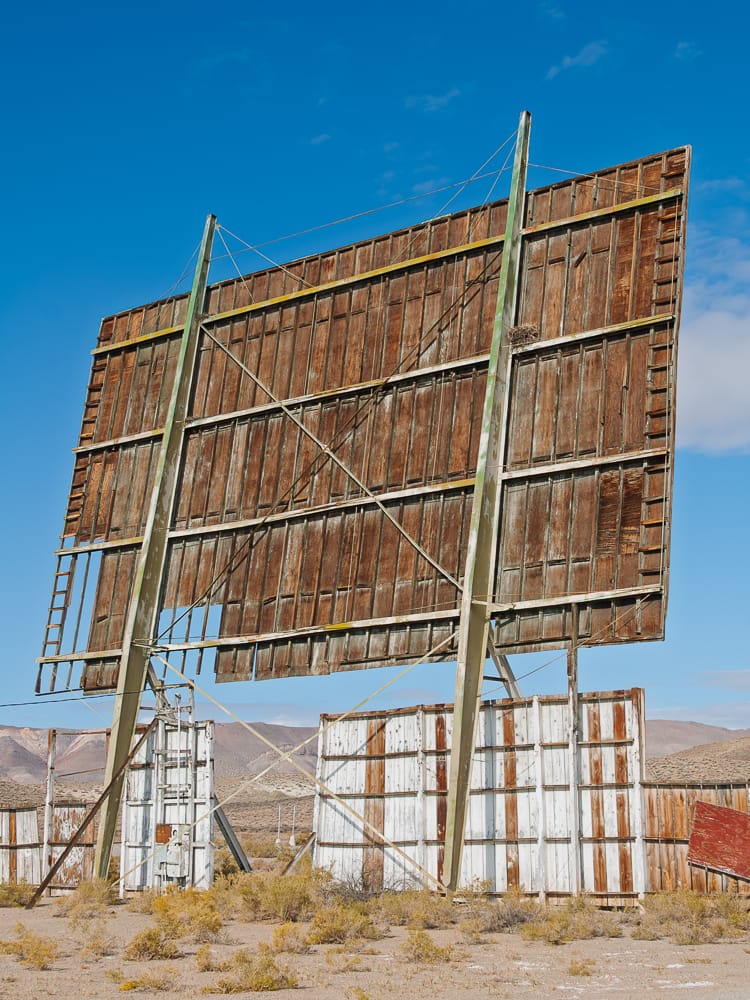
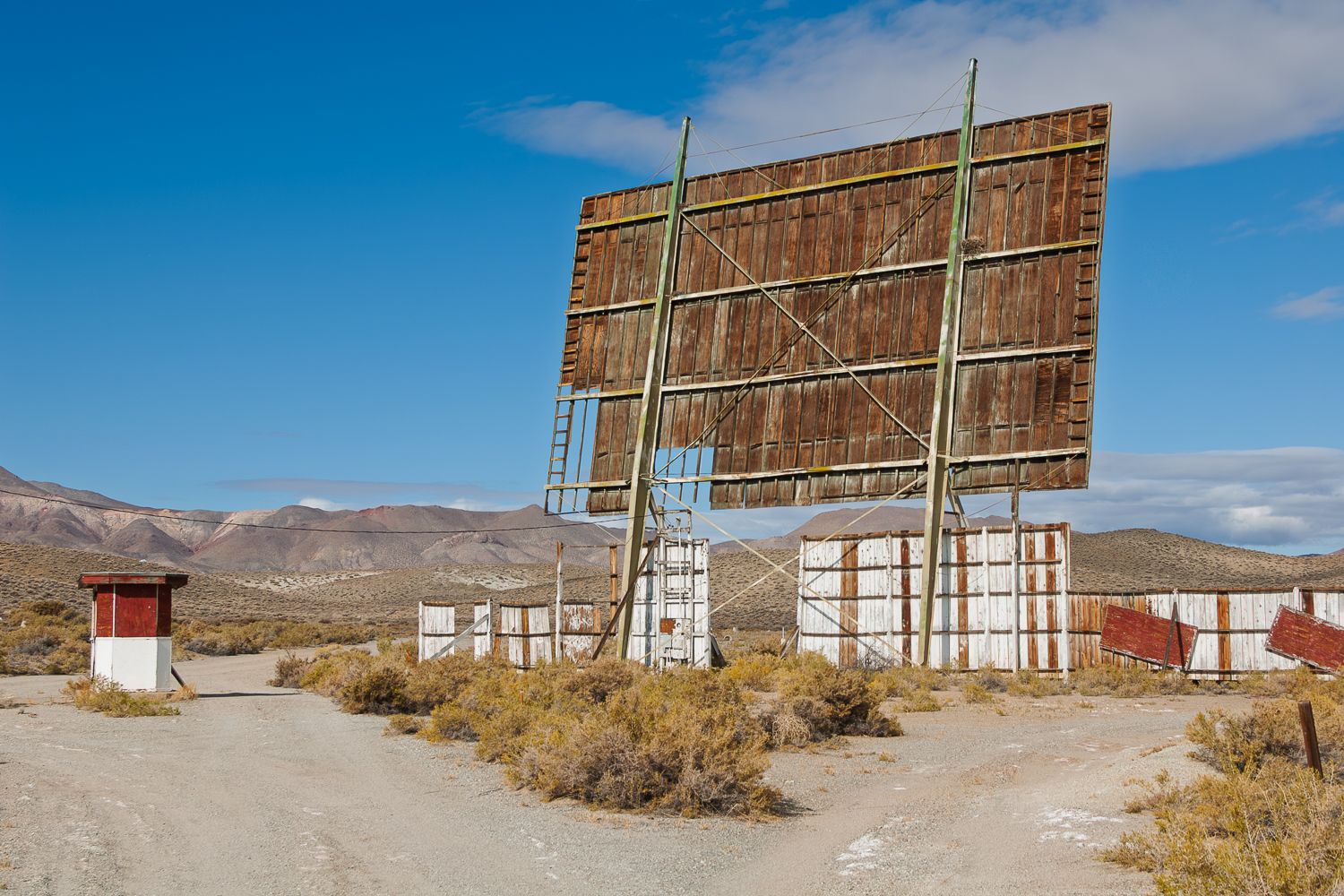
The physical remains are surprisingly complete for a site that has been abandoned for decades. The most dominant element is the huge screen structure, a tall metal frame clad in weathered panels, some missing, some warped, all faded by sun and wind. From the front it feels like a gigantic, peeling billboard; from the rear the exposed latticework gives it an almost skeletal look. Near the entrance, a small, boxy ticket booth still stands by the old access road, its windows empty and its paint flaking. Further inside, a low central building once housed both the snack bar and the projection room; its doors and windows are boarded or open, and desert dust and debris have started to claim the interior. Across the parking area, gentle earth mounds mark the old car ramps, punctuated by short concrete stumps and the occasional remaining pole where speakers once hung. All of this sits in a basin of gravel and sagebrush, with open views to the surrounding hills and a sense of space that is very typical of Nevada.
For photographers, the site offers a rich mix of form, texture and atmosphere. The screen provides a strong, simple shape that anchors wide compositions, especially when framed against dramatic clouds, sunsets or a clear night sky. The peeling paint, rusted metal, cracked concrete and scrub vegetation deliver the sort of fine detail that rewards close-up work and side-light at golden hour. The rows of ramps and the regular spacing of the old speaker posts create natural leading lines that draw the eye towards the screen, making them useful foreground elements in both wide and standard focal lengths. Beyond the purely visual qualities, the place carries a strong narrative: it speaks of communal entertainment, changing technology and rural life, which makes it a powerful backdrop for conceptual portraiture or series about memory, decay and the passing of a particular kind of Americana. At the same time, the structures are old and unstable, so any visit with a camera should be combined with a healthy respect for distance, footing and local rules.
The history of the Sage Crest Drive-In goes back to the early 1950s, when a local family built a drive-in theatre on the edge of town to serve Yerington and the surrounding farming communities. It opened around 1953–1954, originally under a simple “Drive-In” name, with space for a few hundred cars and family-friendly films on the programme. Over time it took on the name Sage Crest, a nod to the low, scrub-covered hills around it. Like many rural drive-ins it had an uneven life: long summers of regular screenings, periods of closure when business dipped, then a relaunch in the late 1980s with new owners and a renewed push to draw crowds, including Spanish-language screenings and community events. By the mid-1990s, economic and technical pressures finally caught up; after its final season in 1995, the projectors went dark for good and the drive-in passed into public hands.
The physical remains are surprisingly complete for a site that has been abandoned for decades. The most dominant element is the huge screen structure, a tall metal frame clad in weathered panels, some missing, some warped, all faded by sun and wind. From the front it feels like a gigantic, peeling billboard; from the rear the exposed latticework gives it an almost skeletal look. Near the entrance, a small, boxy ticket booth still stands by the old access road, its windows empty and its paint flaking. Further inside, a low central building once housed both the snack bar and the projection room; its doors and windows are boarded or open, and desert dust and debris have started to claim the interior. Across the parking area, gentle earth mounds mark the old car ramps, punctuated by short concrete stumps and the occasional remaining pole where speakers once hung. All of this sits in a basin of gravel and sagebrush, with open views to the surrounding hills and a sense of space that is very typical of Nevada.
For photographers, the site offers a rich mix of form, texture and atmosphere. The screen provides a strong, simple shape that anchors wide compositions, especially when framed against dramatic clouds, sunsets or a clear night sky. The peeling paint, rusted metal, cracked concrete and scrub vegetation deliver the sort of fine detail that rewards close-up work and side-light at golden hour. The rows of ramps and the regular spacing of the old speaker posts create natural leading lines that draw the eye towards the screen, making them useful foreground elements in both wide and standard focal lengths. Beyond the purely visual qualities, the place carries a strong narrative: it speaks of communal entertainment, changing technology and rural life, which makes it a powerful backdrop for conceptual portraiture or series about memory, decay and the passing of a particular kind of Americana. At the same time, the structures are old and unstable, so any visit with a camera should be combined with a healthy respect for distance, footing and local rules.
Photography Tips
For strong images at the old drive-in, it helps to think in layers: use the car ramps, concrete stumps or ticket booth as foreground, the screen as a mid-ground anchor and the hills or sky as background, so your photos do not collapse into a flat silhouette. Early morning and late afternoon give you low, directional light that pulls out rust, peeling paint and texture; around sunset you can work with silhouettes of the screen against colour, and after dark you can try long exposures or light painting if you are comfortable with night work. A wide-angle lens captures the whole scene and the sweep of ramps, while a short telephoto is useful for isolating details like bolts, bullet holes, signage or the framing of the projection windows. Try both low viewpoints (crouching near the ground to make the screen loom) and slightly elevated ones if you can safely stand on intact mounds or use a small step stool. Wind is common, so a sturdy tripod is helpful for slower shutter speeds, and closed shoes or boots are a good idea because of broken glass and metal scraps. Finally, avoid climbing on the buildings or the back of the screen, both for your safety and to keep the place intact for the next curious photographer.
Travel Information
Reaching the former drive-in is straightforward. From central Yerington, the route follows the main road west out of town on U.S. 95 Alternate (often signed locally as Goldfield Avenue). After a short drive, the large, pale screen structure becomes visible off to one side in the open desert, along with the low concession building and entrance area. A dirt track branches off the highway and leads up to the old entrance, where the ticket booth still stands. Because the site now lies on public land and conditions can change, it is sensible to check a current map or navigation app under the name “Sage Crest Drive-In” or “Yerington drive-in” before setting out, and to pay attention to any on-site notices about access. The area is quite exposed, so visitors should prepare for heat, sudden weather changes and typical desert hazards. With those basics in mind, the trip is simple, and the reward is a remarkably intact open-air cinema slowly dissolving back into the Nevada landscape.





Spot comments (0)