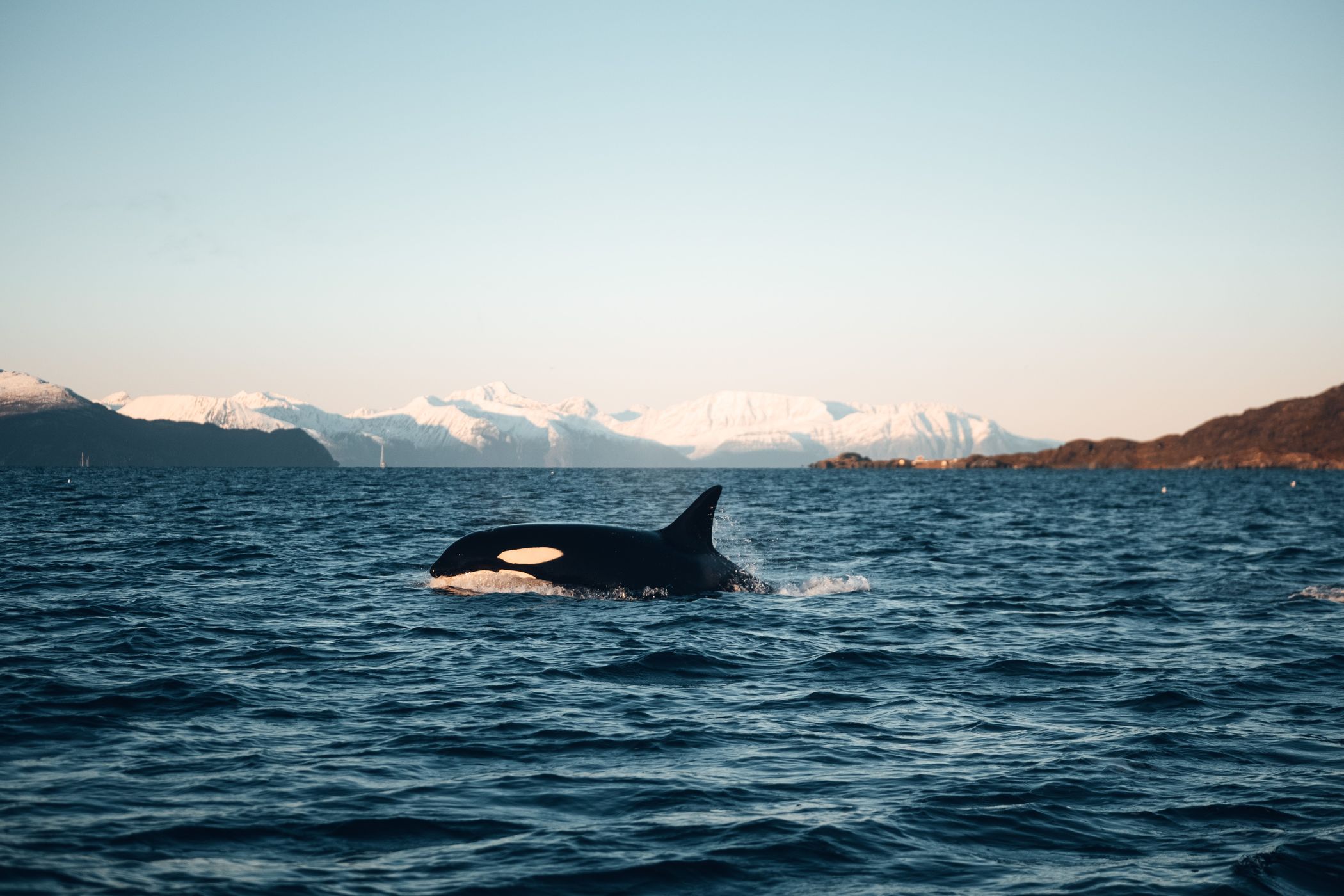

A story of icy fjords, misty breaths in polar air, and one of the most intense wildlife encounters of our lives.
For years, we had dreamed of seeing orcas in the far north - in the wild, cold, crystal-clear waters of Norway, where winter feels sharper, wilder, and more honest than anywhere else. Every year between November and January, an enormous migration unfolds: around 300 million tons of herring enter the fjords of Northern Norway. A feast that attracts orcas, humpbacks, fin whales, and even the occasional sperm whale.
The orcas hunt in teams, herding the herring into bait balls, striking with their tails - precise, powerful, deeply social. Witnessing this with our own eyes had been a lifelong dream. But we were also nervous. Would we handle the icy water, with only a thick wetsuit separating us from the Arctic? What if storms kept us on land for days? Would we even see the whales at all?
The uncertainty is part of the experience - the far north makes no promises. Decades ago, the herring migrated further south. But changing ocean temperatures - likely influenced by climate change - have shifted their route northward. Today, Skjervøy has become one of the most important places on the planet to witness orca feeding behavior. In fact, it’s the only place in the world where you can legally and safely snorkel with wild orcas, under strict guidelines. And in summer? The orcas disappear again. They follow the food - traveling along the Norwegian coast, sometimes toward Svalbard or even Iceland. Much about their summer lives remains a mystery, which makes these short winter weeks even more extraordinary. We’ve seen humpbacks before - but in Northern Norway, they are different.
Here, they rush in from kilometers away the moment orcas form a bait ball. The orcas do the herding, and the humpbacks know it. They appear out of nowhere, rising with force, claiming their share. Of course, there are rules:
- You never swim above a bait ball.
- You never chase the animals.
- You only enter the water if the orcas are calm - and if the guides give the go.
Orcas are often portrayed as dangerous, but there has never been a documented attack on a human in the wild. They are apex predators, yes - but they are also curious, aware, and incredibly intelligent. And maybe that’s why these encounters feel so profound: You are just a guest in their world. A quiet observer of an ancient, perfectly coordinated natural event that happens only here, only now, only for a few fleeting weeks each winter.
Arrival in Tromsø - Excitement Meets Respect
Even during planning, the thought alone gave us butterflies. Orcas - intelligent, enormous, wild. Snorkeling with them - in open water, in Arctic winter.
When we stepped out of the plane in Tromsø, nervousness turned into pure anticipation. Crisp air. Dark blue fjords. The realization: Tomorrow it could happen. Later that day, we boarded our expedition ship. 13 guests from around the world - Norway, Italy, Germany, the US, Australia - all united by the same goal. The atmosphere sparkled with excitement.
During the evening briefing, we tested drysuits, received safety instructions, and as if Norway wanted to welcome us, powerful northern lights lit up the sky above the ship. We looked at each other, speechless, thinking: This is going to be big.

Get the exact geo-position for this spot: Fjord of Skjervoy
Season & Nature
The orca season in Northern Norway runs roughly from late October to February, when the herring arrive - and with them, orcas, humpbacks, and other whales. We visited at the end of October/beginning of November - early in the season, so sightings weren’t guaranteed, but with the sun still up for a few hours during the day. Our goal was to capture the sunrays breaking through the surface, and an Orca underneath. And we were unbelievably lucky: we saw orcas on all 5 possible days.
Six Nights at Sea - Between Zodiac, Ocean & Northern Lights
Our floating home for the week offered:
- a cozy lounge to warm up, work & review images
- cabins to sleep & dry gear
- a chef on board (yes - the food was amazing!)
- two guides, crew & Zodiacs for getting into the water
Our daily rhythm was simple - but intense:
07:00 breakfast → waiting for sightings → “Orca call!” → gear up → Zodiac → water → hot shower → download images → dinner → northern lights → sleep.
Not exactly relaxing. But pure exhilaration.
Days were short, and golden light glimmered across the fjord. Many evenings ended under green, dancing auroras. We stood on deck with cold fingers and warm hearts, whispering, “Oh my god - look at this!”
From the ship, we saw orcas, humpbacks, fin whales, sperm whales - sometimes so close we could hear them breathe.

Get the exact geo-position for this spot: Sperm Whales in Skjervoy
Day 1 - The First Jump
The first snorkel day started slowly. Hours of searching, dreamy light - but no orcas. Doubt crept in. Then suddenly: the first Orcas! Seeing them from the ship was already insane, but it was too windy to jump on the Zodiac. So we just enjoyed the views, the first Orcas I have ever seen, from the boat, and enjoyed that a lot. After a few hours, it was already noon, and we finally got the call:
“On the Zodiac!” Adrenaline hit. Layers of clothing, housing sealed, mask tight. We raced across the water. It was still a bit windy, so we were all showered from the water while we rushed through the ocean. It was cold, but the excitemend still overwhelming. And finally, the call: “Go! Go! Go!” We slid in. Silence below, endless blue- and a slight shock, because the water was freezing cold and crept up onto our faces. And then - a pod of orcas. Swimming straight toward us. No glass. No boat hull. Just us and these black-and-white giants. A look. A moment of awe. And the cold was already forgotten.
You feel tiny - and huge at the same time. Tiny next to them. Huge for being allowed to witness it.
It was just a small moment, very short, but already so intense, and gave the first hint of what to expect in the next days. We breached the surface, looked at each other, and were overwhelmed by how lucky we are. But also the harsh weather left its traces on my body, and I became seasick. That’s why I decided to go back to the big boat while Mathias still stayed, took some motion sickness pills, and rested for the rest of the day, just to make sure I could make it back in the ocean for the next day.

Get the exact geo-position for this spot: Orcas underwater in Skjervoy
Day 2 - Baitball Chaos & A Humpback From Below
The morning began quietly, almost gently.
The fjord was still, the air crisp, and one by one the whales appeared in the soft dawn light - humpbacks, fin whales, even a distant sperm whale silhouetted against the rising sun. It felt like the world was holding its breath. Magical moments, wrapped in silence and awe.
Earlier than the day before, the call came: “Get dressed. Zodiacs in five.”
We hurried into our drysuits, excitement replacing the calm.
The first jumps of the day were already beautiful - orcas passing beneath us like black-and-white shadows, curious, effortless, powerful. Each encounter felt like a gift.
But between the jumps, the reality of the Arctic caught up with us: long stretches on the Zodiac, wind cutting through every layer, fingers stiff, bodies trembling. The kind of cold that settles into your bones.
Still, our guide Jens was focused. He was waiting for the moment - the rare, electrifying event when orcas push a massive herring school into a tight bait ball. That’s when you can stay with them longer, when the ocean turns into a theater of strategy and teamwork.
By late afternoon, soaked and tired, part of me was ready to stay dry. But Jens’ voice suddenly shifted - this was it. The signal we had waited for. We rolled into the water. Immediately, the world exploded into motion. Our first bait ball. A swirling storm of thousands of herring, flashing silver in the blue. Orcas circling tight - choreographed, precise, perfectly in sync. Tail slaps cracking through the water, coordinated passes, constant communication clicks and whistles echoing all around us. The ocean felt alive, vibrating with purpose. We watched them work. Up and down. Left and right. Black-and-white shapes weaving through the chaos. We could feel the strategy, even if we understood only fragments of their language.
And then - everything changed. A shadow rose from the depths. Fast. Huge. Growing with every second.
Out of the deep, a humpback whale surged upward - a sudden explosion of mass and movement - and with one single, massive gulp, swallowed the entire bait ball right in front of us. I screamed into my snorkel - shock, awe, pure adrenaline. Goosebumps from head to toe. One moment: thousands of fish, dozens of orcas, a perfect formation.
The next: silence, bubbles, and one very satisfied humpback disappearing into the blue.
I made my way through the blue, kicking hard, searching for Mathias in the chaos of bubbles and fading silver scales. When I finally spotted him, we locked eyes - and both of us just screamed into our snorkels. Pure excitement. Pure disbelief. Pure adrenaline. What we had just witnessed didn’t feel real. A moment so wild, so sudden, so perfectly timed that our bodies didn’t know whether to laugh or cry. So we did both - floating there, wide-eyed, shouting through our masks like two kids who had just seen magic for the first time. It was one of those rare moments, you know, even as it happens, that you’ll carry it with you forever.

The baitball

The baitball
Day 3 - Morning Magic
Our breakfast at 7:30 ended abruptly when the guides exchanged a quick look - that subtle spark of excitement you learn to recognize up here. Before sunrise, the radios crackled again. Another chance. Another call. Orcas.
We rushed to get ready, fumbling with layers and zippers, because in Skjervøy every minute truly counts.
Here, far above the Arctic Circle, everything lives in rhythm with the sea. In winter, the fjords become a gathering point for millions of herring, and where the herring go, the orcas follow. It’s one of the few places in the world where you can witness this spectacle so close, so raw, so real. The fjord was still wrapped in a soft blue dawn when we arrived - glassy, silent, almost holding its breath. But below the surface, everything was in motion. Another bait ball. And once again, only our small group of snorkelers.
We slid into the water just as the first golden rays pierced the horizon, turning the sea into molten gold. Blue everywhere. Cold, crisp, endless Arctic blue.
And then… black and white shapes slicing through the light. Precision. Power. Coordination. The orcas circling, chasing, communicating in a language we can only guess at.
A photographer’s dream, unfolding right in front of our lenses. Some photographers travel to Skjervøy year after year, hoping for this exact moment - orcas illuminated by the rising sun, the last of the night dissolving into gold around them. And somehow, against all odds, we were lucky enough to get it on our third day. It felt like the Arctic had opened a door just for us.

Orca illuminated by the rising sun.
Day 4 - Zodiac encounters
Today we spent the entire day out on the Zodiac, scanning the fjord, watching the light change from steel-blue to silver. The orcas were around, but something felt different. No bait balls, no coordinated hunts - just loose, fast-moving groups cutting through the water with purpose. They seemed unsettled, almost protective.
We didn’t push them. If they aren’t comfortable, we stay on the boat.
That’s the rule - and honestly, the only way to experience this place with respect.
A few orcas came close, riding our wake, curiously checking us out. They even “played” with the bubbles from the propeller, weaving in and out as if testing us, but the moment to enter the water never felt right. And that’s okay. Watching them from above the surface, feeling the breath of the fjord and the raw power beneath us, was just as special.
Later, we learned that a newborn calf had joined the pod today - maybe that explains the tension in the water, the way the adults kept shifting position, forming loose shields around the smaller animals.
And then there was the humpback.
Completely convinced, it seemed, that he was part of the orca crew. He followed them everywhere - not for the social bonding, of course, but for the food. A giant, gentle shadow drifting behind the black-and-white torpedoes, hoping for leftovers. We couldn’t help but laugh. Even the orcas looked a little confused.
A strange day. A beautiful day. Not the encounters we expected - but the kind that stays with you.

Get the exact geo-position for this spot: Whale watching in Skjervoy
Day 5 - The Goodbye Moment
We floated side by side, silent, breathing slowly through our snorkels, letting the cold northern sea hold us. For once, the current didn’t pull us apart. For once, we weren’t drifting in different directions, chasing different shadows in the blue.
Just us. Waiting. All week, we had spent hours on the Zodiac - scanning the horizon, reading the fjord, following the faint signs of movement. The ocean doesn’t operate on schedules, and the Orcas certainly don’t. Most encounters were fleeting, scattered, with both of us focusing on different places at once. But now… it felt like everything aligned.
Two orcas appeared out of the quiet, gliding toward us with an almost unreal calm. Not hunting. Not rushing. Just… approaching. They passed only a few meters in front of our masks - slow, deliberate, as if they saw us, acknowledged us, and offered a wordless goodbye. A farewell you couldn’t script better in a movie. We stayed on the surface long after they faded into the endless blue. Goosebumps. Silence. And a wave of gratitude that hit harder than the cold. A last moment - shared, finally shared - after days of chasing wildlife, bouncing across the fjord, and slipping into the water at different times and places.
It felt like the ocean’s way of saying: Here. This one’s for both of you.

Saying good bye to the Orcas.
Gear, Cold & Practical Tips
Snorkeling was done in a dry suit + thick underlayer – surprisingly warm in the water, colder on the Zodiac (especially hands & face).
Our camera setup:
- 2× Fujifilm X-T5 in underwater housings 16 and 18 mm focal lenses with 1.4 f stop - a lot of light goes missing below the surface
- Action cams mounted for video
- X-T50 in a dry bag in the Zodiac for above-water shots 100-300mm lens
- phone for videos
- tripod for aurora- when strong enough, it still works on the “moving” boat
Pack list essentials:
- motion sickness pills (trust us)
- dry bags for Zodiac rides
- plenty of memory cards
- a towel to clean the camera on the zodiac
Next time, we might try wetsuits for more flexibility.

Costs & Logistics
- Price range ~ €3,000–6,000 per person (excluding flights)
- Route: Germany → Oslo → Tromsø → ship to Skjervøy
- Duration: 6 nights / 5 potential snorkel days
Best for:
✔ photographers & filmmakers
✔ wildlife-respectful adventurers
✔ physically fit travelers
Not ideal for:
✘ comfort-holiday seekers
✘ fear of water/cold
✘ those expecting guaranteed encounters
What We Took Home
Terabytes of footage.
But more importantly: humility, gratitude, and deep respect.
And the wish to return one day – knowing how lucky we were.
If we had to describe the expedition in one word?
Breathtaking.
Check out the Youtube Video.




Comments (0)