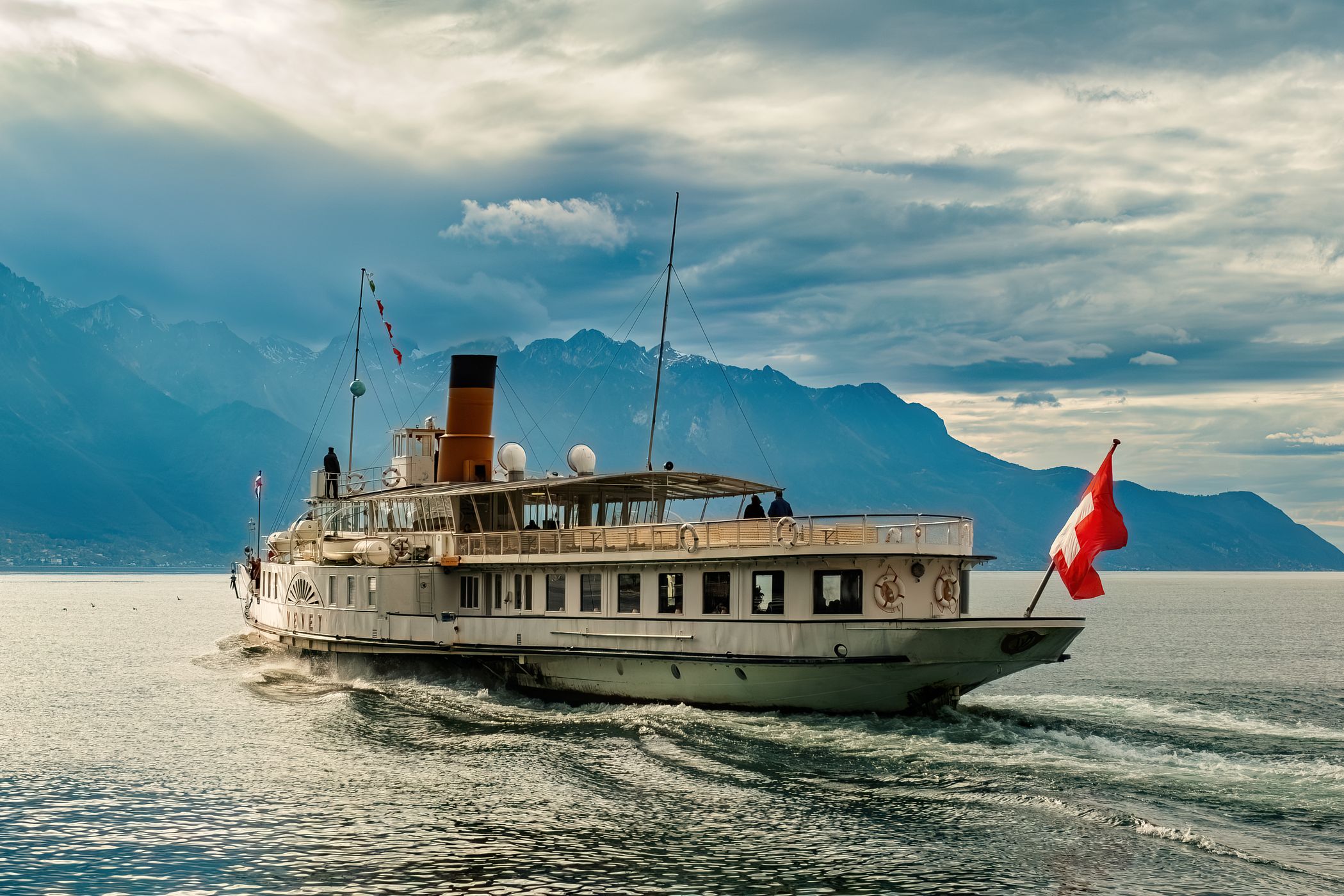

Switzerland Débarcadère of Montreux
1. A short history
Most of the classic vessels on Lac Léman belong to the Compagnie Générale de Navigation (CGN). They were built in the late 19th and early 20th century, in the belle époque when lakes were the motorways of polite society. People travelled in hats, luggage was made of leather, and engineering was meant to be seen, not hidden. The steamers linked the Swiss towns on the north shore with the French side, moved tourists, mail and occasionally ambitious politicians. Several of these ships were later modernised, some were converted to diesel-electric drives, but the external appearance was kept deliberately historical so that the lake still looks like Switzerland is showing off.
2. What they look like
They are long, elegant, low ships with:
a pointed bow that slices the water;
side paddle wheels covered with decorative housings;
a tall, single funnel in warm colours (cream, yellow, black);
open decks with benches and lifebuoys;
flags at bow and stern, often Swiss and cantonal;
brass, wood and painted details that make every close-up a potential photo.
They are not speedboats. They are stage sets on water.
3. Why they are photography gold
Because they give scale. A steamer in front of the Alps tells the viewer immediately: this is Lake Geneva, not some random reservoir. The ship adds human presence without needing to photograph humans. It also gives movement to a landscape that is otherwise “mountains + water + sky”. On cloudy days the white hull stands out; on sunny days the funnel and flags pop; in bad weather the steamers look heroic. Architecture, heritage and landscape in one frame: that is rare.
Most of the classic vessels on Lac Léman belong to the Compagnie Générale de Navigation (CGN). They were built in the late 19th and early 20th century, in the belle époque when lakes were the motorways of polite society. People travelled in hats, luggage was made of leather, and engineering was meant to be seen, not hidden. The steamers linked the Swiss towns on the north shore with the French side, moved tourists, mail and occasionally ambitious politicians. Several of these ships were later modernised, some were converted to diesel-electric drives, but the external appearance was kept deliberately historical so that the lake still looks like Switzerland is showing off.
2. What they look like
They are long, elegant, low ships with:
a pointed bow that slices the water;
side paddle wheels covered with decorative housings;
a tall, single funnel in warm colours (cream, yellow, black);
open decks with benches and lifebuoys;
flags at bow and stern, often Swiss and cantonal;
brass, wood and painted details that make every close-up a potential photo.
They are not speedboats. They are stage sets on water.
3. Why they are photography gold
Because they give scale. A steamer in front of the Alps tells the viewer immediately: this is Lake Geneva, not some random reservoir. The ship adds human presence without needing to photograph humans. It also gives movement to a landscape that is otherwise “mountains + water + sky”. On cloudy days the white hull stands out; on sunny days the funnel and flags pop; in bad weather the steamers look heroic. Architecture, heritage and landscape in one frame: that is rare.
Photography Tips
a) Time of day
Morning from Montreux/Vevey: the sun comes from behind you and lights the ship nicely.
Late afternoon from Lausanne/Ouchy: warm side light on the steamer, Alps in calmer tones.
Golden hour: reflections on the lake are softer, the ship looks less contrasty.
b) Positioning
Shoot from the débarcadère (jetty) as the ship arrives or leaves. That’s when it turns and shows its full profile.
If possible, get slightly above water level (quay, terrace, promenade wall). A tiny bit of height makes the deck and passengers visible.
Use the mountains as a backdrop. Try to avoid a flat horizon with no peaks; Lake Geneva rewards diagonals.
c) Lenses
24–70 mm: ideal for context + ship.
70–200 mm: perfect for picking up details (paddle wheel, flags, crew, nameplate).
Wide angle only if you are very close and want to exaggerate the bow.
d) Shutter speed & water
1/500 s or faster to freeze the spray behind the stern.
1/125–1/250 s if you want a tiny bit of motion in the water.
On misty days a polariser helps to deepen colour and remove glare from the lake.
e) Include people—sparingly
One person on deck looking forward gives scale and narrative (“journey!”). Twenty people give chaos. Wait half a minute.
f) Weather is not the enemy
These ships look magnificent against incoming weather from the Rhône end of the lake. Dark clouds + white steamer = drama without Photoshop.
Morning from Montreux/Vevey: the sun comes from behind you and lights the ship nicely.
Late afternoon from Lausanne/Ouchy: warm side light on the steamer, Alps in calmer tones.
Golden hour: reflections on the lake are softer, the ship looks less contrasty.
b) Positioning
Shoot from the débarcadère (jetty) as the ship arrives or leaves. That’s when it turns and shows its full profile.
If possible, get slightly above water level (quay, terrace, promenade wall). A tiny bit of height makes the deck and passengers visible.
Use the mountains as a backdrop. Try to avoid a flat horizon with no peaks; Lake Geneva rewards diagonals.
c) Lenses
24–70 mm: ideal for context + ship.
70–200 mm: perfect for picking up details (paddle wheel, flags, crew, nameplate).
Wide angle only if you are very close and want to exaggerate the bow.
d) Shutter speed & water
1/500 s or faster to freeze the spray behind the stern.
1/125–1/250 s if you want a tiny bit of motion in the water.
On misty days a polariser helps to deepen colour and remove glare from the lake.
e) Include people—sparingly
One person on deck looking forward gives scale and narrative (“journey!”). Twenty people give chaos. Wait half a minute.
f) Weather is not the enemy
These ships look magnificent against incoming weather from the Rhône end of the lake. Dark clouds + white steamer = drama without Photoshop.
Travel Information
You have multiple, civilised options:
By train: This is Switzerland, trains behave. Montreux, Vevey, Lausanne and Geneva all have frequent services. From the station it is usually a 5–10 minute walk down to the lake to the CGN pier. The timetable is coordinated so that you can actually catch the boat.
By car: Motorway A9 (for Montreux/Vevey) or A1/A9 (for Lausanne). Parking near the lake can be limited on sunny weekends, so arrive a bit earlier if you want the departure shot.
By boat: The most stylish way. Take one steamer to photograph the other. When two of them cross on the lake, you get the most authentic “belle époque on water” scene.
From the French side (Évian, Thonon): CGN runs connections across the lake; check the current schedule before you go, because services vary by season.
At the pier, arrive 10–15 minutes before departure. The captain will manoeuvre the ship close, slow down, pivot, and that is your best composition window. After that, the steamer leaves, the wake draws a perfect S-curve on the water, and you get the iconic rear shot with the Swiss flag leaning out like it is in a painting.
The nice thing about these vessels: they are working heritage. They are not museum pieces nailed to a quay. They move, they sound alive, and they keep the memory of steam-age lake travel visible. Photographing them means documenting how a region remembers itself. That is always worth pressing the shutter.
By train: This is Switzerland, trains behave. Montreux, Vevey, Lausanne and Geneva all have frequent services. From the station it is usually a 5–10 minute walk down to the lake to the CGN pier. The timetable is coordinated so that you can actually catch the boat.
By car: Motorway A9 (for Montreux/Vevey) or A1/A9 (for Lausanne). Parking near the lake can be limited on sunny weekends, so arrive a bit earlier if you want the departure shot.
By boat: The most stylish way. Take one steamer to photograph the other. When two of them cross on the lake, you get the most authentic “belle époque on water” scene.
From the French side (Évian, Thonon): CGN runs connections across the lake; check the current schedule before you go, because services vary by season.
At the pier, arrive 10–15 minutes before departure. The captain will manoeuvre the ship close, slow down, pivot, and that is your best composition window. After that, the steamer leaves, the wake draws a perfect S-curve on the water, and you get the iconic rear shot with the Swiss flag leaning out like it is in a painting.
The nice thing about these vessels: they are working heritage. They are not museum pieces nailed to a quay. They move, they sound alive, and they keep the memory of steam-age lake travel visible. Photographing them means documenting how a region remembers itself. That is always worth pressing the shutter.
Spot Type
Outdoor
Crowd Factor
Lots of people
Best Timing
Summer
Sunrise & Sunset
07:53 - 18:41
| current local time: 04:33
Photo Themes
Paddle Steamer
Ship
Vintage boat
Locations
Saxon Switzerland
Canton Vaud
Lake Geneva
Vaud
Montreux





Spot comments (0)